
Profit for the Pitch: Celtic v Rangers: Part One

Updated: 6 days ago
Few football rivalries define the identity of their city as extensively as the Old Firm.
Through generations, Rangers and Celtic competed for players and domestic silverware, European nights and, of course, the bragging rights. Although these honours were won on the pitch, the players were provided by the business off the pitch. The business of the club is brought together in the boardroom and back offices, which connect the corridors of power through the tunnel, to the pitch. This competition is measured in money on the financial tables, rather than match points on the league table. This is the financial competition.
When you wish to understand how the Old Firm became so competitive on the pitch today, it helps to chart milestones in their journey through the last four decades and answer the question:
How did Rangers and Celtic, starting from broadly similar positions, end up with such grossly different financial profiles?
1985 — When English clubs disappeared from Europe

Following the Heysel disaster in 1985, English clubs were banned from European competitions. The ban lasted for five years, with Liverpool serving an additional season. From 1977 to 1984, 3 English clubs collected 7 of the 8 European Cups.
Scottish clubs were unaffected and Rangers struck silver. First by recruiting three-time European champion Graeme Souness as Player-Manager to attract from England top players who might otherwise have been winning trophies on the European stage. The ban on English clubs saw European Champions Graham Roberts, Chris Woods and Terry Butcher take the high road to Scottish football.

The transformation of Souness' strategy started more than a decade of dominance for Rangers from 1986 as they won three League Flags before Souness’ successor, his Assistant Walter Smith, took the reigns in 1990/91.
1990s - Rangers Rule the Waves

The Rangers board reinforced the success of its team on the pitch by expanding the capacity of Ibrox stadium and surrounding commercial operations. These investments in the business of the club generated incomes to boost the budget for success on the pitch in the years to come.
Whereas Celtic was entering a troublesome time. Their average league attendance in 1989/90 was around 28,600, compared with circa 38,400 at Ibrox. Financially, Celtic’s annual budget was also weaker at approximately £6.4m. That season Celtic’s net spend on transfer fees alone was reported as under £1m - less than half that of Rangers.
Meanwhile the tide was turning in England as its clubs returned to European competition and Sky Sports invested in the Premier League to herald a new era of riches for football in England.

Across the Clyde, in 1994 Celtic was about to capsize - its bank called in a £5m overdraft and put it on the brink of bankruptcy. Fergus McCann came from Canada to underwrite the club’s debt and a share issue to fans for a financial restructuring that enabled an extensive reorganisation.
Nevertheless Rangers maintained momentum by investing up to £60m in transfer fees to secure superstars like Brian Laudrup from AC Milan, Paul Gascoigne from Lazio and Basile Boli, who had just scored the winner for Marseille against Milan in the 1993 European Cup Final.
Rangers’ 9IAR
Rangers Football Club was not just winning League Flags. It was building for a decade of dominance.

Walter Smith built upon the success of the Souness strategy to transform the team. Murray combined significant investment in the squad, with investment in infrastructure off the pitch, in order to sustain domestic dominance on the pitch.
In 1991 the capacity of Ibrox was increased to around 44,500 with the addition of the Club Deck. In 1992/93, they completed the domestic treble by adding the Scottish Cup and League Cup to the League Flag. On the way to finishing third in the European Cup, Rangers won the famous 'Battle of Britain' by beating English champions Leeds United.
Rangers was achieving what every football club wants: dominance. Because the board created a business that was big enough to support the team.
From 1988/89 through to 1996/97, Rangers won nine consecutive Scottish league titles in a row (9IAR).

By 1997/98, Rangers’ turnover of £32.5m was £4.7m (14%) above Celtic. In a table of turnover by British clubs, Rangers sat sixth - behind only Manchester United, Newcastle, Chelsea, Liverpool and Arsenal. Despite eight years of English clubs being back in Europe and six years of the Premier League living in the new media world of Sky Sports.
Celtic Stop Ten
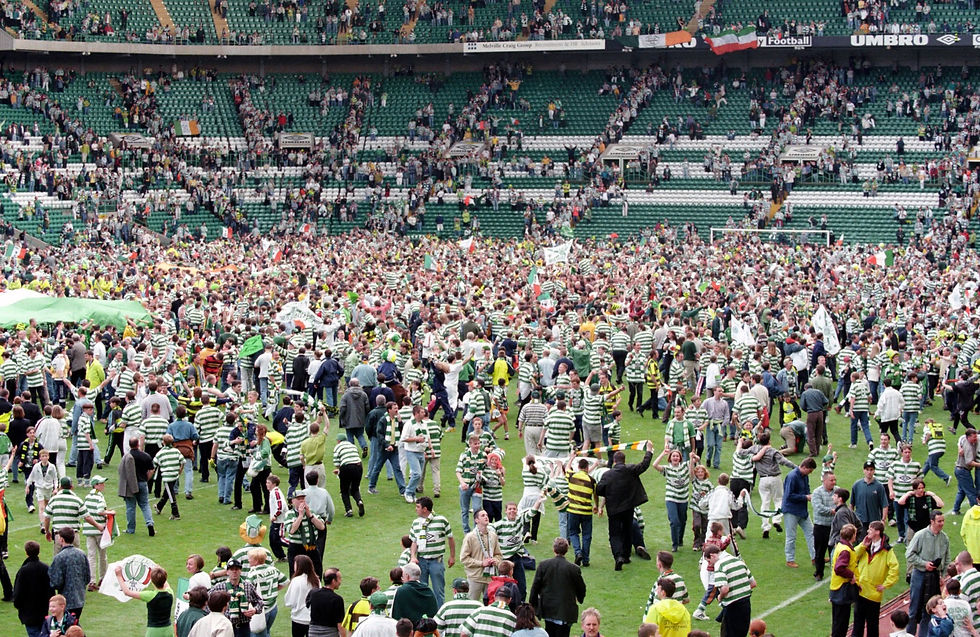
But nine was not ten. In 1997/98, Celtic stopped Rangers from completing the ten-time sequence by winning the league title themselves. Celtic had rebuilt its foundations, investing in its finances and stadium. Now that investment was starting to pay off on the pitch.
On the surface, it was simply the end of Rangers' nine-in-a-row. But it was brought about by winning the financial competition.
McCann had stripped Celtic back to its core and rebuilt business around it, like Murray had done at Rangers in the early 1990s. However McCann dug deeper by almost doubling the capacity for seating at Celtic Park from 34,000 to 60,000. Upon completion in 1998, it was the largest stadium of any club in the UK. While Rangers was limited to a capacity of around 50,000.
Glasgow was getting another colossus.
The story was far from over. Part Two follows Rangers' further pursuit of European success and the financial consequences that followed.
If you are considering investment in sport, our dual-qualified professionals in accountancy and law can expedite the delivery of your strategy. Call Gibson Alexander.


Comments